Mobile Personal Trainer Canberra
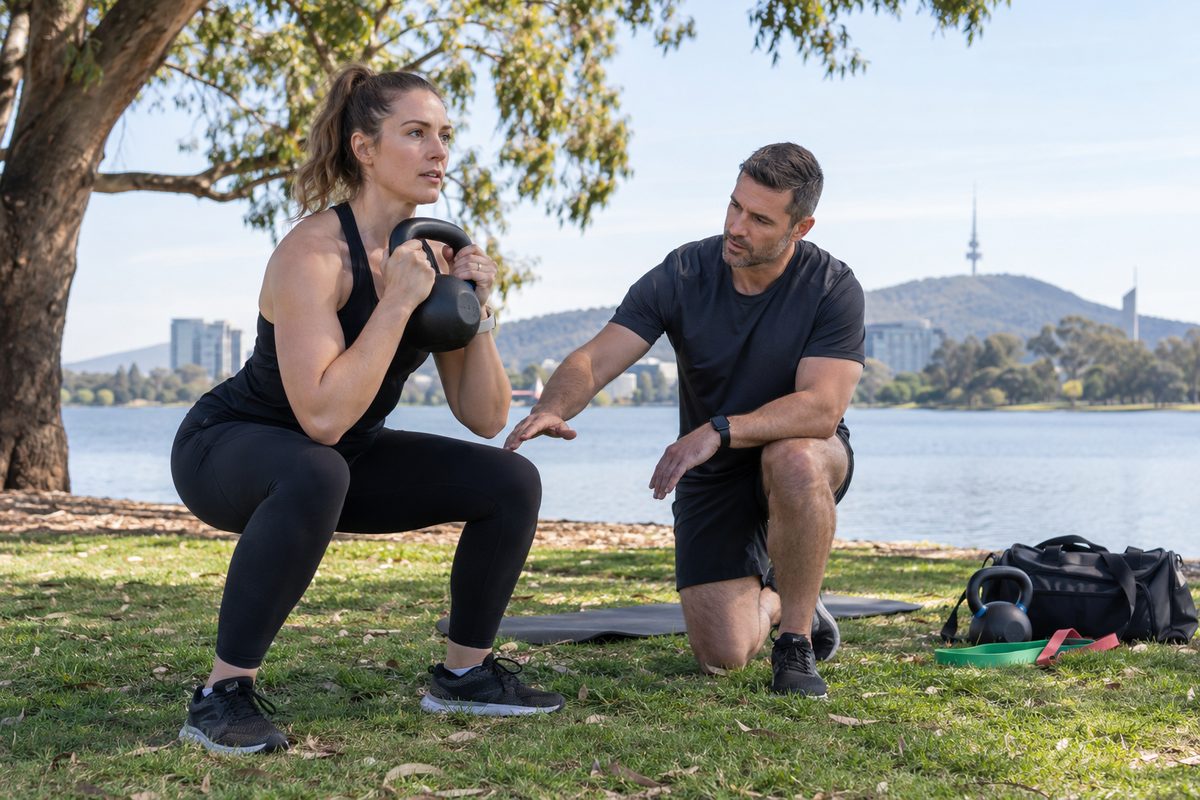
A mobile personal trainer canberra brings the workout to you, training you at home, in your driveway, or at an outdoor spot across the city instead of inside a gym. That sounds simple, but it changes how the whole session works. There is no front desk, no waiting for a machine, and no drive across town after work. The trainer turns up with the gear, runs the session where you are, and leaves again. For a lot of Canberra residents, that one change is the difference between training three times a week and not training at all.
What Does a Mobile Personal Trainer Actually Do?
A mobile personal trainer plans your program, brings portable equipment, and coaches you through the session on your own ground. The job is the same as any professional fitness coach. The difference is the setting, not the standard of coaching.
I had a client in North Canberra who worked rotating shifts at a hospital. She could never commit to a 6am gym slot because her roster changed every week. We moved her sessions to her backyard instead. Some weeks that meant 7am, some weeks it meant 3pm. The program did not change. Only the clock did. That flexibility is the actual product you are paying for with a mobile trainer, not just the convenience of skipping a commute.
Where Do Sessions Happen Across Canberra?
Sessions happen wherever makes sense for the client and the goal. In Canberra, that tends to fall into a few patterns.
- Home sessions: driveways, garages, or backyards across suburbs in North Canberra and beyond, usually for clients who want privacy or have young kids at home.
- Trail and bush training: Stromlo Forest Park gets used a lot for hill sprints, step-ups on natural terrain, and longer conditioning sessions. The terrain itself adds a challenge no flat gym floor can match.
- Waterside sessions: the paths around Lake Burley Griffin suit circuit work, bodyweight stations, and steady cardio blocks for clients who want scenery while they sweat.
- City lunchtime sessions: clients working near Woden Town Centre often book a trainer for a 45 minute session during their lunch break, since there is no commute to a gym and back.
The location is chosen around the person, not the other way round. A client who hates mornings but has a flexible lunch hour gets a different plan than a shift worker training at dawn.
What's Actually in a Mobile Trainer's Kit?
A good mobile trainer carries a small set of tools that cover almost every movement pattern a gym machine would train. The core of that kit is usually a resistance band, a kettlebell or two, a suspension trainer, and a mat.
This is where functional training earns its name. Instead of isolating one muscle on a machine, you work movements your body actually uses, squatting, pulling, pressing, carrying. A resistance band alone can load a row, a press, a squat, and a rotation pattern. I know this because one of my clients trained for four months using nothing but bands and a kettlebell while her garage was being renovated, and her strength numbers kept climbing the whole time. Equipment limits are rarely the real barrier to progress. Programming is.
How Do You Know Your Trainer Is Actually Qualified?
Check three things before you book: a recognised qualification, current first aid, and insurance. Anyone calling themselves a professional fitness coach in Australia should hold a Certificate III and IV in Fitness, recognised under the Australian Qualifications Framework. That qualification is the baseline. It is not optional, and it is not something you should take on trust.
First aid matters just as much, especially outdoors. A session at Stromlo Forest Park or along Lake Burley Griffin is further from help than a gym floor with staff on site. Your trainer should hold a current first aid certificate and know exactly what to do if a session goes wrong.
Then there is insurance. A trainer operating without professional liability insurance is a risk to you, not just to them. Insurance covers injury claims and negligence claims if something happens during a session. I always ask new trainers I work with to show their current certificate before I recommend them to anyone. If a trainer hesitates or gets vague when you ask about insurance, that is your answer.
What Happens If Something Goes Wrong During a Session?
A properly qualified trainer treats the injury, stops the session safely, and follows up afterwards. This happened with one of my clients who rolled her ankle stepping off a curb during a park circuit. Her trainer had current first aid training, assessed the injury on the spot, iced it using a cold pack from his kit, and called her a lift home rather than letting her drive. That is what the first aid certificate and the insurance are actually for. They are not paperwork. They are what separates a serious coach from someone who just bought a kettlebell and a logo.
Can Outdoor and At-Home Training Build Real Strength and Lose Real Weight?
Yes. Progressive overload drives results, not the brand of equipment you use. Progressive overload means the resistance, reps, or difficulty increases over time. A resistance band loaded correctly and increased week on week builds muscle hypertrophy just as well as a cable machine does for most clients in the first year of training.
I had a client whose only goal was weight loss after two kids and a desk job. We started with bodyweight squats and a light resistance band in her living room. Twelve weeks later she was doing banded deadlifts at double the resistance, and she had dropped nine kilograms. Nothing about that result needed a gym. It needed a program, consistent sessions, and someone adjusting the load every few weeks. Goal setting at the start of that program mattered more than the equipment ever did. We wrote down a number, a date, and a weekly check-in, and that structure is what kept her showing up.
Who Actually Suits Mobile Training Over a Gym Membership?
Mobile training suits people who train better with one-to-one accountability and without the social pressure of a gym floor. In my experience, that covers new parents who cannot leave the house easily, shift workers whose hours never match a gym timetable, older clients who feel self-conscious in a commercial gym, and busy professionals near places like Woden Town Centre who want to train without burning their lunch break on travel.
It does not suit everyone. Someone who loves the energy of a group class or who trains best surrounded by other people lifting heavy will probably get more out of a gym. What I found was that clients who struggle with motivation on their own, rather than with equipment access, get the biggest jump in consistency from switching to mobile sessions. The trainer showing up at your door removes the decision to skip a session. That decision is where most training programs actually fail.
What Should You Do Next?
Before booking a mobile personal trainer in Canberra, ask to see their Certificate III and IV in Fitness, their current first aid certificate, and proof of professional liability insurance. Then book one trial session at a location that suits your week, whether that is your own driveway, a lunchtime slot near Woden Town Centre, or a morning circuit by Lake Burley Griffin. Judge the trainer on whether they adjust the plan to your goals and your life, not on how much equipment they carry.